the Indiana Bears?

[Welcome to our annual Guest Writers Series. Meet articulate contributor #9...]
I don’t know about the rest of the world, but those of us living in Chicago have been subjected to a daily barrage of fact, fiction, opinion, rhetoric, and various other forms of clickbait over the past several years claiming to have the inside scoop on the future home of the Chicago Bears.
A synopsis for those uninformed:
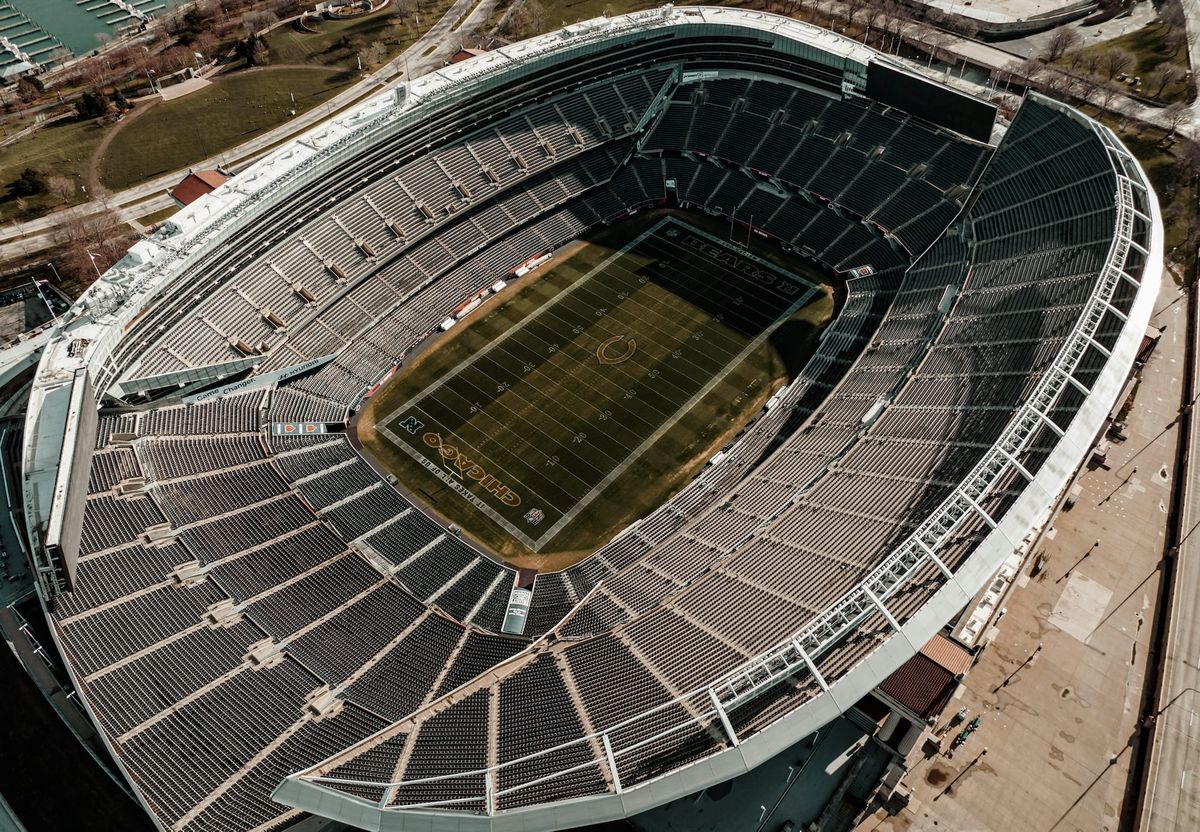
The Bears have one of the worst stadium deals in the NFL. At 61,500 seats, it is the smallest stadium in the league. The Bears rent the stadium from the Chicago Park District, limiting the team’s ability to monetize the surrounding space, control parking, or profit in any way from non-football events. The Bears are one of the few teams in the league who do not own the lucrative naming rights to their stadium. Hence, we honor veterans with “Soldier Field” while SoFi is paying the LA Rams and Chargers $400 million and Allegiant pays the Las Vegas Raiders $25 million per year.
In an attempt to modernize the stadium, in typical Illinois fashion, Chicago spent $632 million on a $400 million budget to renovate Soldier Field in 2003. Of that amount, $432 million was raised by issuing bonds, originally set to mature over 35 years. But because Chicago keeps refinancing the bonds rather than paying them off, the total cost is projected to exceed $1.1 billion by the time the bonds mature.
Worse than that, dropping a steel bowl into the existing concrete façade made the facility even smaller, creating an architectural monstrosity that can only be described as resembling an alien spaceship landing in the Roman Colosseum, resulting in the stadium losing its status as a National Historic Landmark in 2006.
I’m not sure how anyone could have seen this as the right long-term answer. It simply kicked the can down the road and laid the seeds for the dilemma being faced today.
Fast forward to 2023, the Bears purchased a 326-acre plot of land in Arlington Heights, the old Arlington Park horse racing track in the western Chicago suburb. However, as soon as they did so, Cook County raised the assessed value of the land from $33 million to the Bears’ purchase price of $197 million, increasing the property taxes from $1.25 million to $7.5 million per year. This immediately raised the Bears’ concern as to what their tax bill would be should they build a multi-billion-dollar stadium on the site. Fears of a $50 million annual tax bill were both legitimate and stifling. Thus began a 3-year saga in search of tax certainty for the Bears.
In April 2024, the Bears and Chicago Mayor Brandon Johnson announced plans to build a new stadium on the lakefront directly south of Soldier Field. That May, Illinois Governor J.B. Pritzker called those plans a “non-starter.” In September of 2025, the Bears announced that they were moving forward with Arlington Heights as their “future home.” In December, they released a statement that they were also exploring northwest Indiana as a potential stadium site. In February 2026, Indiana passed a bill creating the funding mechanism for such a stadium. The Bears waited for Illinois to complete its legislative session. After no action was taken, in June, the Bears Board of Directors voted unanimously to advance their stadium development project in Hammond, Indiana. Not a done deal, but it’s getting close.
This ordeal says so much about so many. Let’s examine the situation from each of their perspectives:
Illinois Governor J.B. Pritzker
April 2024 – Publicly expressed skepticism about the team’s proposal for a new stadium, explicitly stating he had “higher priorities for the state.”
October 2025 – Reaffirmed his stance, telling business leaders that he opposed major public financing for a new Bears stadium, calling it unfair to everyday taxpayers.
Fall 2025 – Communicated to the Bears that a stadium deal was not a priority for the 2026 legislative session.
December 2025 – Called it a “startling slap in the face” for the Bears to consider stadium options in northwest Indiana.
Spring 2026 – Said he was doing “everything I can do” to secure the Bears future in Illinois.
June 1, 2026, after the legislature adjourned with no deal – “I wasn’t willing to give up billions of dollars of taxpayer money in order to give it to a billionaire-owned family or team” and “We didn’t have time” to get a deal done.
Which is it, Governor? Was it not a priority, were you doing everything you could, or were you not willing to do it? Does this guy think we don’t remember the last thing he said? Pritzker has presidential ambitions. If the state loses the Bears, I don’t think he could win Illinois.
Chicago Mayor Brandon Johnson
May 21, 2026 – “The Chicago Bears have exhausted every opportunity to stay in Chicago, which was our initial goal. There is not a viable site in the city. As a result, the only sites under consideration are in Arlington Heights [Illinois] and Hammond [Indiana].” – The Chicago Bears
June 5, 2026 – “There’s no plan in Hammond. There’s none of that in the suburbs. We [Chicago] are already further along than any other site.” – Brandon Johnson
What J.B. Pritzker says is inconsistent. What Brandon Johnson says is nonsensical. His approval rating is down to 23%, with only 13.6% of Chicagoans wanting him to run again. He has $631 thousand raised for a reelection campaign. His likely opponent has raised $22 million. And the Bears haven’t even left yet. To borrow an iconic phrase from Monday Night Football, “Turn out the lights, the party’s over.”
Illinois Government
There are two aspects of Illinois politics that are either disingenuous, dysfunctional, or both. Each branch of the statehouse stayed well into the night on the last day of the legislative session, trying to give the impression that they were doing everything possible to get something done. Both houses passed a bill, but neither even took a vote on the other’s bill. The Senate passed theirs at 4am, and the House adjourned without taking action on it. They each were able to say that they got something done. But collectively, they got nothing done. Classic Illinois politics.
But this situation perfectly exemplifies the fundamental problem with Illinois government. The Illinois House has 118 members, 78 of whom are Democrats, 31 of whom are from Chicago. The Illinois Senate has 59 seats, 40 of whom are Democrats, 20 of whom are from Chicago. The Democratic Party runs the State of Illinois, and Chicago runs the Democratic Party. In short, you can’t get anything done without Chicago, and those politicians refused to pass a bill that would take the Bears out of the city, even if that means the team leaves the state.
This is why 33 of Illinois’ 102 counties have already passed a referendum to explore separating from Cook County (Chicago) and forming a new state. The referendum has passed in every county in which it has been put to a vote, typically with about 70% support. And it is on the ballot in 7 more counties this November.
Indiana Government
Check the timeline. The Bears bought the Arlington Heights property in 2023, and Illinois hasn’t gotten anything done in 3 years. (Pritzker: “We didn’t have time.”) Meanwhile, when the Bears announced in December 2025 that they were exploring a move out of state, Indiana signed a stadium bill into law 2 months later. In Illinois, the Democrat Governor and Democrat Mayor of Chicago keep bickering, pointing fingers at each other as to whom is to blame. In Indiana, the Republican Governor and Democrat Mayor of Hammond worked together to get something done. Indiana works. Illinois does not.
Conclusion
Is it really a good deal for the public to underwrite these huge stadium deals for NFL teams? Indiana obviously thinks so, and it would be a huge boost to civic pride in a region that has long suffered from industrial blight. But independent economists overwhelmingly agree that sports stadiums are poor public investments, diverting funds from other priorities. Furthermore, anyone familiar with Leroy Brown knows that the southside of Chicago is “the baddest part of town.” Putting a state-of-the-art stadium just across the state line (which is closer to Soldier Field than Arlington Heights) will no doubt create economic development between here and there, where it is badly needed.
The sky is not falling. The Kansas City (Missouri) Chiefs recently announced that they are moving to Kansas City, Kansas. The New York Giants moved to New Jersey in 1976, and the New York Jets followed in 1984. Every game has been a sellout ever since, for the past 50 years. They will still be known as the Chicago Bears, a concession Mayor Johnson claims to have secured from the team, even though it was never in question.
So let it happen, and let Indiana foot the bill. The sports fan’s insatiable appetite for the NFL will not be diminished. The Bears will be fine.
But Illinois may not be.
CAZ